
Tinder Shadowban 2026: Are You Banned — or Is Your Profile Just Weak?
Matches dropped to zero overnight? Learn how to test for a dating app shadowban on Tinder, Bumble and Hinge, the real causes behind lost visibility, and a safe 7-day recovery plan. Plus the 10 photo mistakes that make your profile invisible and how to build a natural-looking AI headshot set.
ON THIS PAGE
If your matches dropped to zero overnight, wondering whether you have been shadowbanned is completely normal. Most people asking that question are not banned at all; their visibility has dropped, their photos are weak, or the algorithm has lost confidence in their profile. A smaller group really is restricted for a policy violation.
This guide helps you tell the difference. You will get the signs and tests first, then the real causes, and finally a safe 7-day recovery plan. One important note: this is not a ban-evasion guide. Creating a new account, using a VPN or resetting your device usually makes things worse and violates platform terms.
#The short answer: is a shadowban even real?
No. "Shadowban" is not an official penalty published by any of the major dating apps. Tinder, Bumble and Hinge apply warnings, content removals, suspensions or account bans for rule violations. They do not publish a separate category called hidden visibility restriction.
In practice, what people call a shadowban is usually one of four things:
- A real account restriction: A violation removed your profile from discovery.
- A ranking decline: Your account is active, but weak engagement signals mean it is shown less.
- A technical issue: Location, filters, verification or an app bug is blocking visibility.
- Profile quality: Your photos, bio and verification are causing people to swipe past.
So the first step is not to panic about a ban. It is to identify which scenario you are in.
Note: Platform rules and features vary by country and change over time. The information below reflects publicly available sources as of October 20, 2026. Check the platform's current terms for definitive rules.
#8 signs you are actually invisible
| # | Sign | Signal strength |
|---|---|---|
| 1 | Matches dropped to zero overnight | Strong |
| 2 | The "likes you" count has not moved in days | Strong |
| 3 | A Boost or Spotlight gets no views at all | Strong |
| 4 | Another account cannot find your profile | Medium-strong |
| 5 | A photo was removed or you are stuck in verification | Strong |
| 6 | Your message reply rate suddenly collapsed | Weak |
| 7 | The drop started right after a profile edit | Medium |
| 8 | There is an official warning or violation notice in the app | Definitive |
No single sign is proof. Two or three strong signals together are worth investigating.
#4 tests: shadowban or weak profile?
#Test 1: The friend test
Ask a trusted friend to set their distance to maximum and swipe slowly in your area for 10 to 15 minutes on a healthy account. If you do not appear after 200+ profiles, that is meaningful. Their account should be in a similar demographic and in good standing.
#Test 2: The Boost test
Use a Boost or Spotlight and note the view count. If an account that normally gets views gets zero impressions after a paid boost, a visibility restriction becomes more likely. This test costs money, so complete the free checks first.
#Test 3: Variable control
What changed on your profile in the last 14 days? New photos, new bio, new location, new filters? If you changed several things at once, you cannot tell which one caused the problem. Change one variable at a time and wait 5 to 7 days.
#Test 4: Policy check
Does your profile contain any of these?
- Someone else's photo or a stock image
- Heavy editing that clearly changes your face
- An old photo that misrepresents your age or appearance
- A phone number, social handle or external link in the bio
- Spam, sales or adult-content signals
- The same photos used on another account
If any of these apply, fix them before you go looking for a shadowban.
#8 real causes of lost visibility
#1. User reports and behavior violations
This is the most common real cause. Harassing messages, unsolicited explicit content, abuse, spam or pushy behavior can trigger a review. In that case you will usually receive a warning or a content-removal notice.
#2. Duplicate accounts and ban-evasion signals
Opening a new account with the same phone number, email, device, IP or payment details can look like ban evasion to a trust system. That often gets the new account restricted quickly too.
#3. Reusing the same photos
Community reports suggest platforms may use image hashing. Moving photos from a previously banned account to a new one can trigger automated review. This is not an officially confirmed mechanism, but many users report being restricted again after uploading the same frames.
#4. Misleading or heavily edited photos
The shared rule across platforms is a ban on misrepresentation. Heavy skin smoothing, reshaping your face, using a photo from 10 years ago or filters that make you unrecognizable can fall into that category. The issue is not AI itself; it is whether the photo still looks like you.
#5. Verification mismatch
Features such as Tinder's Photo Check use facial scanning to confirm that a photo belongs to a real, live person and has not been digitally altered. If your profile photo differs significantly from your verification video, verification can fail and visibility can suffer.
#6. Automation, bots and rapid-fire swiping
Third-party apps, auto-likers and hundreds of swipes in a short window produce non-human behavior signals. The algorithm can read that as low-quality engagement.
#7. Profile signals
An incomplete profile, too few photos, an external link in the bio, contact details or sales language reduce trust with both users and the system. The account is not necessarily banned; it is simply shown less.
#8. Device, network and location signals
Community experience suggests that accounts opened on the same device or network, and inconsistent location changes, can raise a risk score. Platforms do not disclose these signals, so treat them as possible factors rather than certain causes.
#Photo audit: 10 mistakes that make you invisible
Visibility is a loop: good photos → more impressions → more engagement → higher ranking. Bad photos start the opposite loop. This is where most people who think they are shadowbanned actually lose their reach.
Audit your profile against these 10 points:
- Is your first photo clear and current? It should be from the last 12 months and show your face easily.
- Is your face large enough in the frame? A small face becomes tiny inside a profile circle.
- Is there heavy filtering? Plastic skin, erased pores and exaggerated eye enlargement reduce trust.
- Do you look like the same person? Facial structure, hair and age should be consistent across photos.
- Is a group photo your only shot? If people cannot tell which person you are, it should not be first.
- Are sunglasses, a mask or heavy shadow hiding you? Nothing should cover your face in the main photo.
- Is the resolution high enough? At least 1080 pixels; blurry, pixelated images are penalized by both users and the algorithm.
- Is the background competing with you? A messy room, crowded venue or text-heavy wall distracts.
- Do you have a full-body photo? A profile of only close-up faces feels incomplete.
- Does it represent the real you? A photo that makes a date say "is that you?" is the biggest trust killer of all.
#The ideal six-photo set
| Slot | Photo type | Purpose |
|---|---|---|
| 1 | Clear, smiling head-and-shoulders portrait | First impression and recognizability |
| 2 | Full-body shot in good light | Proportion and confidence |
| 3 | Hobby or activity photo | Conversation starter |
| 4 | Social proof with friends | Trust |
| 5 | Travel or lifestyle shot | Cultural and social signal |
| 6 | Warm, intimate close-up | Approachability and warmth |
While filling this set, keeping the same face, age and overall appearance matters more than any single photo.
#The safe boundary for AI headshots
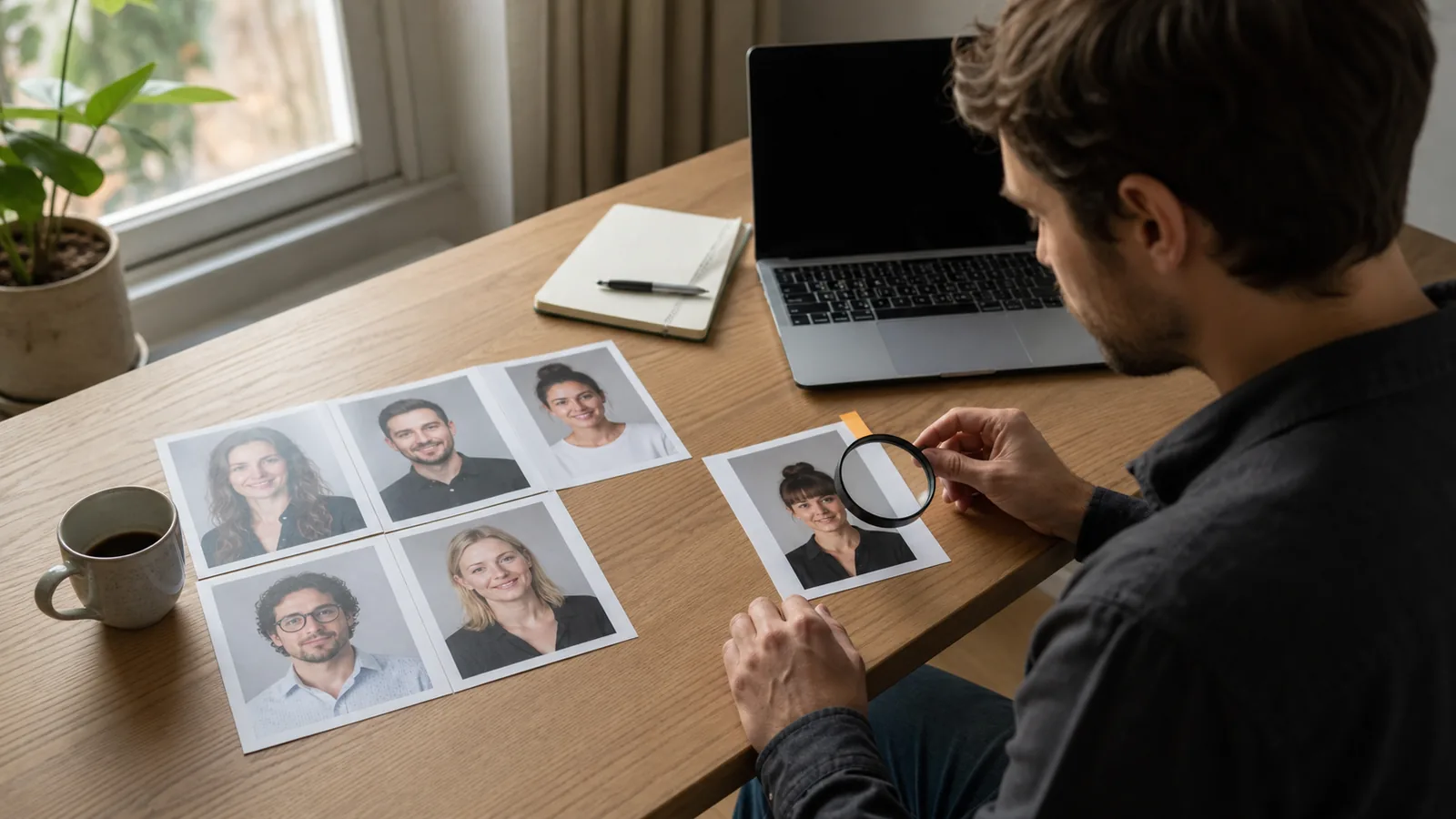
Using an AI-assisted profile photo is not automatically against the rules in 2026. Tinder's terms, updated in March 2026, place responsibility for AI-generated content on the user and tie it to accuracy. Hinge takes a more cautious line on authenticity, and Bumble is more sensitive to edited or artificial-looking images.
The safe boundary looks like this:
- Preserve your identity. Do not change your facial features, age, body type or skin tone.
- Mix in real photos. Industry practice suggests roughly 60% real and 40% enhanced/AI-assisted. Do not use six AI photos on their own.
- Stay consistent with verification. Your profile photo should not look like a different person from your live verification frame.
- Check the current terms. Rules vary by country and change over time.
- Be honest. You do not have to announce anything in your bio, but your photos must not misrepresent you.
#Signs a photo looks AI-generated
- Plastic, poreless skin
- Inconsistent light direction within one image
- Distorted ears, collars or jewelry
- An unnaturally symmetrical face
- Unrealistic background depth
- Errors in hands and fingers
- Features that do not match your other photos
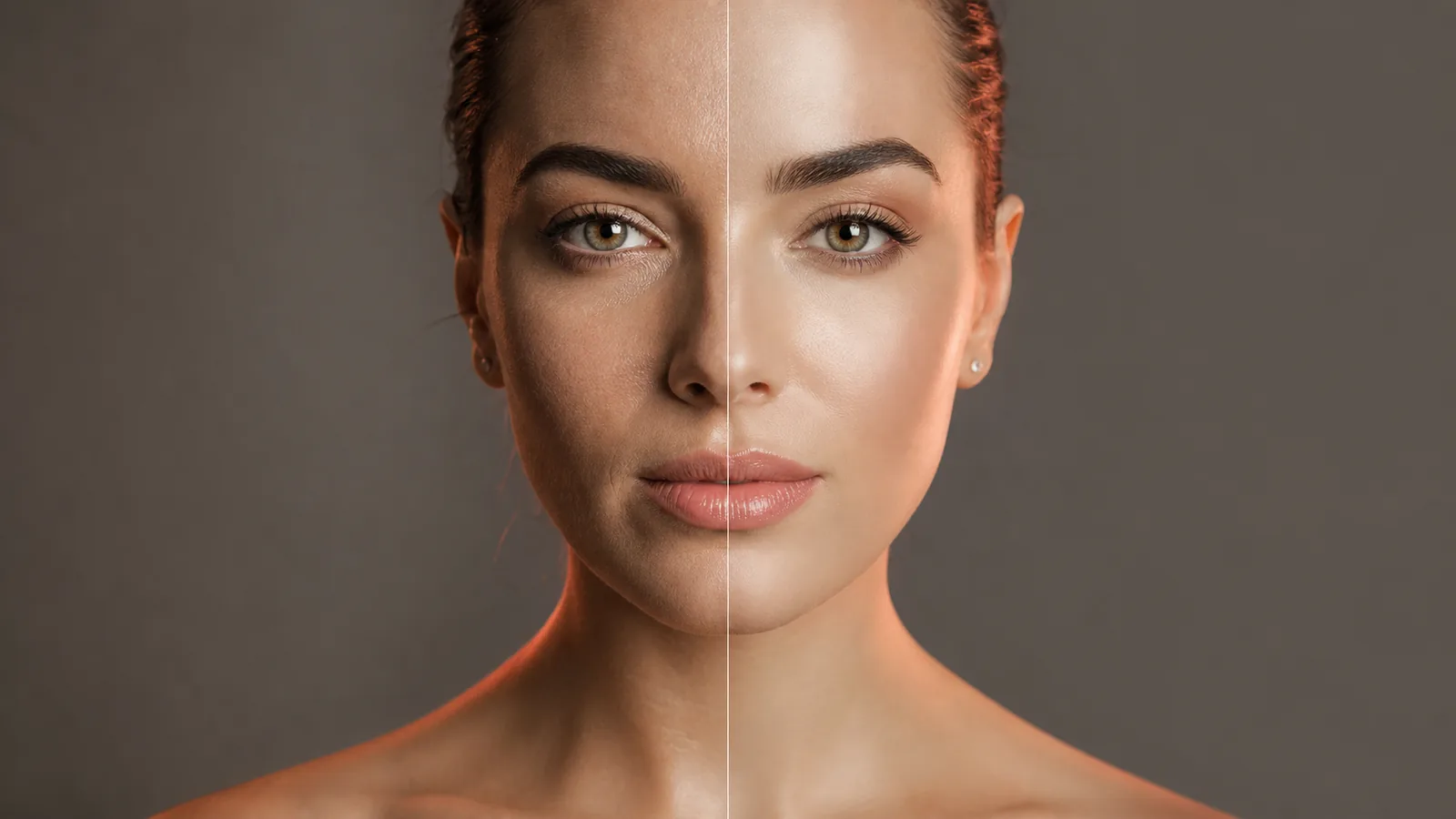
Nothron's workflow is designed to reduce those risks: Neural Headshot Generator creates headshots from your existing photos while preserving your identity; Neural Engine improves resolution and clarity; Natural Glow balances skin tone without over-smoothing. The goal is not to make you look like someone else. It is to show you on a good day.
#The 7-day recovery plan
This is a trust-repair plan, not a ban-evasion plan. Apply each step one at a time and track the results.
| Day | Action | Why |
|---|---|---|
| 1 | Pause swiping for 48 to 72 hours; screenshot your current match and view counts | Panicked changes blur the picture |
| 2 | Remove the 1 to 2 riskiest photos; complete verification | Misrepresentation and verification mismatch are common causes |
| 3 | Run the photo audit; add a clear portrait, a full-body shot and an activity photo | Restart the engagement loop |
| 4 | Simplify the bio; remove links, phone numbers and external calls to action | Clean up profile signals |
| 5 | File an official appeal if you have a notice; otherwise send one clear support message | Move the issue to the official channel |
| 6 | Return to slow, selective swiping: 15 to 30 minute sessions, only profiles you genuinely like | Produce human behavior signals |
| 7 | Compare results; change only one more variable | Measure which fix worked |
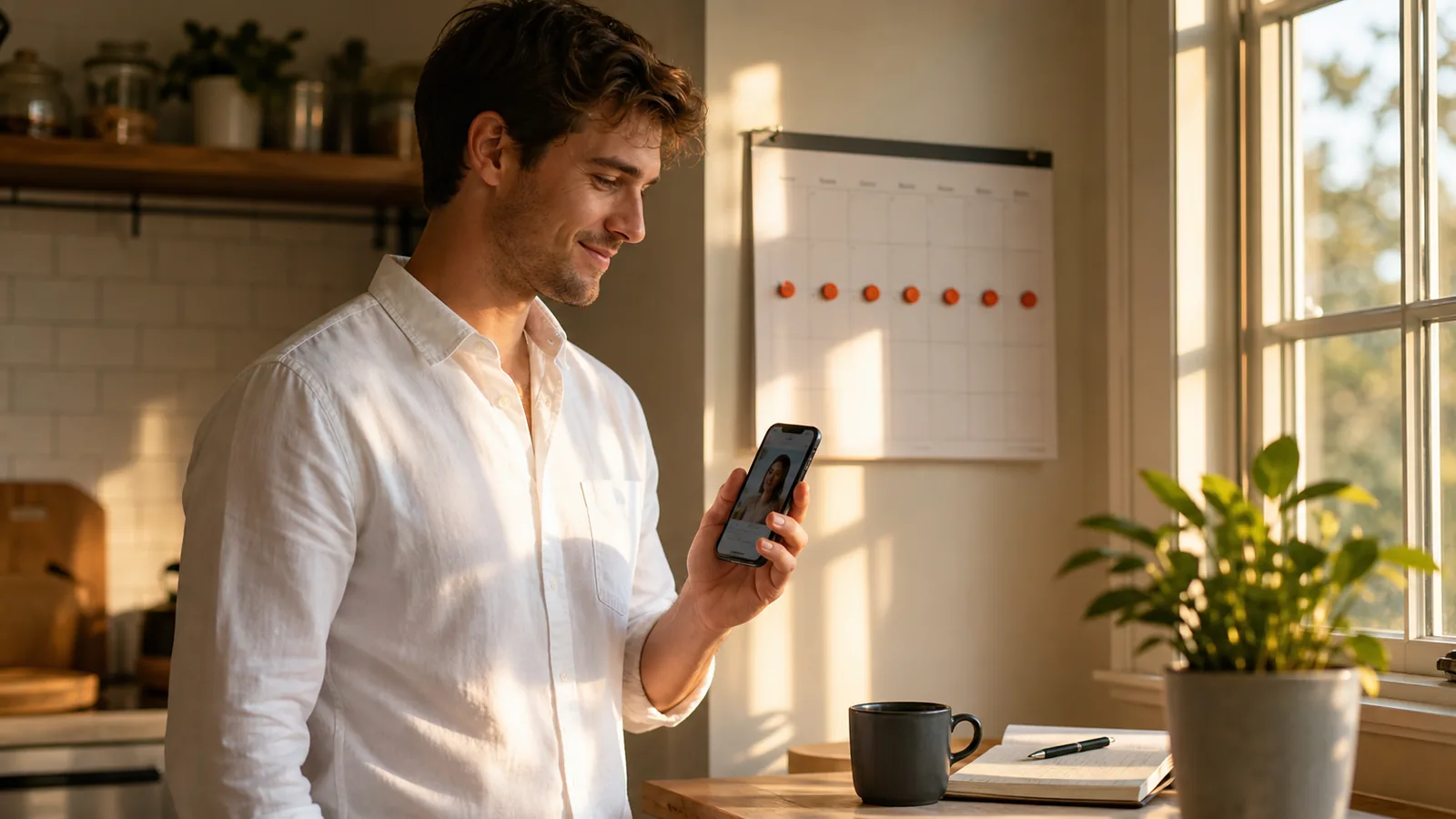
Measurement tip: Match count alone is not enough. Track profile views, likes received, reply rate and the match-to-conversation conversion together.
#What you should never do
These actions may look like quick fixes, but they put your account at long-term risk:
- Create a new account. The same phone, device, network and photos create ban-evasion signals.
- Use a VPN or change location. An inconsistent location history can lower your trust score.
- Reset your device or buy a new SIM. Platforms do not rely on device identity alone; behavior and content are tracked too.
- Try to alter photo hashes. Visual similarity detection is built to resist that.
- Use bots, auto-likers or bought accounts. This is an explicit rule violation.
- Send dozens of appeals at once. It slows the review process.
None of these methods is part of this guide. The goal is not to trick the account. It is to build a compliant, trustworthy profile.
#Official appeals: Tinder, Bumble and Hinge
#Tinder
Use Tinder's official Appeals Center. Sign in with the banned account, select the relevant violation and follow the Begin appeal steps. Include dates, context and verifiable facts. Save the confirmation number.
#Bumble
Submit a support request through the help center in the Bumble app. Choose the topic for account restrictions, photo removal or verification issues. Keep it short and factual, and share identity proof only when requested.
#Hinge
Appeal through Hinge's help center. Because Hinge is strict about authenticity and accurate representation, make it clear that your photos are current and belong to you.
Language that helps: "I would like my account reviewed. My photos are my own and current. I do not understand the violation that was flagged; if you can share details, I will correct the issue."
#Platform differences
| Topic | Tinder | Bumble | Hinge |
|---|---|---|---|
| Is "shadowban" official? | No | No | No |
| Most common cause | Reports, duplicate accounts, fast swiping | Verification, edited photos | Authenticity, misleading profile |
| Photo verification | Photo Check | Photo verification | Profile verification |
| AI photo tolerance | Moderate | Lower | More cautious |
| Appeal channel | Appeals Center | Help center | Help center |
| First recovery step | Remove risky photo, verify | Complete verification, return to natural photos | Use real, current photos |
#Frequently asked questions
#How can I tell if I am shadowbanned on Tinder?
There is no single definitive sign. If zero matches, a frozen likes count, a Boost that gets no views and a friend who cannot find your profile all happen together, a visibility restriction is plausible. None of these is an official diagnosis, so rule out weak photos, narrow filters and technical issues first.
#How long does a shadowban last?
Platforms do not publish a duration for something they do not officially call a shadowban, so there is no guaranteed timeline. Policy-related restrictions usually last until an appeal review is complete. Visibility drops can recover within days to a few weeks once behavior, photos and engagement improve. Creating a new account during this period usually makes things worse.
#Should I create a new account if I am shadowbanned?
No. A new account can be flagged as ban evasion because of the same phone number, device, IP address and photo similarity. That weakens trust signals and raises the risk of a permanent restriction. Use the official appeal channel, remove risky photos and bring the profile into line with the rules instead.
#Can an AI headshot cause a shadowban?
An AI-generated photo is not automatically a ban trigger; most platforms punish misleading representation rather than the tool used. A photo that clearly changes your face, age or body, looks plastic, or does not match your verification video can create a trust problem. Use AI headshots that preserve your real likeness and mix them with real photos.
#My matches dropped but I received no warning. Am I definitely shadowbanned?
No. Most drops without a warning are ranking and engagement declines, not restrictions. Seasonal demand, tight distance or age filters, a recent profile edit, a weak first photo or rapid-fire swiping can all produce the same result. Test one variable at a time before resetting anything.
#How do I appeal a Tinder ban?
Use Tinder's official Appeals Center. Sign in with the banned account, select the relevant violation and follow the Begin appeal steps. Write one short explanation with dates and verifiable facts, and do not attach documents the form does not request. Save the confirmation number and avoid sending repeated requests.
#Do Bumble and Hinge have shadowbans too?
None of the three platforms publishes a separate penalty called a shadowban. Bumble tends to be stricter about verification and heavily edited photos, while Hinge is stricter about authenticity and accurate representation. If visibility drops, check the platform's current community rules and your verification status first.
#Which photos hurt my visibility?
The riskiest photos are heavily filtered or plastic-looking skin, photos taken years ago, group-only shots, sunglasses that hide your face, low resolution, someone else's photo and images that do not match your verification. Your first photo should be clear, current and recognizably you.
#How quickly can I recover my visibility?
There is no guaranteed timeline. After removing risky photos, completing verification, simplifying the profile and pausing rapid swiping for 48 to 72 hours, many users report improvement within one to three weeks. That is a community observation, not an official promise.
#Is it allowed to enhance my profile photo with AI?
What matters is whether the photo accurately represents you, not how it was made. Improving light, resolution, skin tone and composition without changing your facial features, age or body is generally considered safe. Still, check each platform's current terms and keep at least a few real photos in your set.
#Conclusion
A "shadowban" sounds mysterious, but the answer is usually mundane: a policy violation, a verification mismatch or weak profile signals. Before resetting your account, follow this order:
- Run the signs and tests.
- Clean up risky photos and bio signals.
- Complete verification.
- File an official appeal if needed.
- Measure one variable at a time for seven days.
The most overlooked step is the third one: your photos. If your first photo is clear, current and looks like you, both users and the algorithm give you more of a chance. Nothron Neural Headshot Generator can turn your existing selfies into a natural, studio-quality headshot; Neural Engine can raise resolution, and Natural Glow can balance skin tone without overdoing it.
Your first photo is free. No card, no complicated setup: upload a photo and see the difference in seconds.
#Related guides
- Dating App Profile Photo Guide 2026
- Best Dating App Profile Pictures
- Tinder & Instagram Photo Clarity and Aura Guide
- Dating Apps Photo Guide 2026
- Top 5 AI Headshot Generators 2026
- Professional Headshot Guide by Profession
Disclaimer: This content is for informational purposes only and is not affiliated with Tinder, Bumble or Hinge. Platform rules and features change; use the platform's current terms and official support channels for definitive information about your account. This guide does not provide or endorse ban-evasion methods.
Nothron Team
The Nothron team turns experience in AI, computer vision and professional photography into a photo studio that anyone can use.
Related articles
Dating App Profile Photo Guide 2026: 21x More Matches with AI
Jun 18, 2026 · 15 min read
Dating App Photo Guide 2026: Bumble, Hinge, Tinder and Others - The Most Detailed and Ultimate Guide
May 11, 2026 · 17 min read
The Secret to Getting Noticed on Tinder and Instagram in 2026: Photo Clarity and Aura
Apr 28, 2026 · 5 min read